

N
Hi! My name is Nhut Nguyen. I am a software engineer and a writer in Copenhagen, Denmark.
Learn more about me at nhutnguyen.com
Search for a command to run...
Hi! My name is Nhut Nguyen. I am a software engineer and a writer in Copenhagen, Denmark.
Learn more about me at nhutnguyen.com
No comments yet. Be the first to comment.
A simple example of using C++ switch

Two dynamic programming techniques to solve Leetcode 120. Triangle. One has space complexity O(n^2). The other is O(n).

An example of using a sliding window approach and an unordered map to track character positions

A simple C++ solution to Leetcode 1695. Maximum Erasure Value using a sliding window approach and prefix sums.

Strategies to avoid them will help you excel in your following technical interview

Every valid email consists of a local name and a domain name, separated by the '@' sign. Besides lowercase letters, the email may contain one or more '.' or '+'.
For example, in "alice@leetcode.com", "alice" is the local name, and "leetcode.com" is the domain name.
If you add periods '.' between some characters in the local name part of an email address, mail sent there will be forwarded to the same address without dots in the local name. Note that this rule does not apply to domain names.
For example, "alice.z@leetcode.com" and "alicez@leetcode.com" forward to the same email address.
If you add a plus '+' in the local name, everything after the first plus sign will be ignored. This allows certain emails to be filtered. Note that this rule does not apply to domain names.
For example, "m.y+name@email.com" will be forwarded to "my@email.com".
It is possible to use both of these rules at the same time.
Given an array of strings emails where we send one email to each emails[i], return the number of different addresses that actually receive mails.
Input: emails = ["test.email+alex@leetcode.com","test.e.mail+bob.cathy@leetcode.com","testemail+david@lee.tcode.com"]
Output: 2
Explanation: "testemail@leetcode.com" and "testemail@lee.tcode.com" actually receive mails.
Input: emails = ["a@leetcode.com","b@leetcode.com","c@leetcode.com"]
Output: 3
1 <= emails.length <= 100.
1 <= emails[i].length <= 100.
emails[i] consist of lowercase English letters, '+', '.' and '@'.
Each emails[i] contains exactly one '@' character.
All local and domain names are non-empty.
Local names do not start with a '+' character.
Domain names end with the ".com" suffix.
Do exactly the steps the problem describes:
Extract the local name.
Ignore all characters after '+' in it.
Ignore all '.' in it.
Combine the local name with the domain one to form the clean email address.
#include<string>
#include<iostream>
#include<vector>
#include <unordered_set>
using namespace std;
int numUniqueEmails(vector<string>& emails) {
    unordered_set<string> s;
    for (auto e: emails) {
        auto apos = e.find('@');
        string local = e.substr(0, apos);           // extract the local name
        local = local.substr(0, local.find('+'));   // ignore all characters after '+'
        for (auto it = local.find('.'); it != string::npos; it = local.find('.')) {
            local.erase(it, 1);                     // remove each '.' found in local
        }
        s.insert(local + e.substr(apos));           // combine local name with domain one
    }
    return s.size();
}
int main() {
    vector<string> emails = {"test.email+alex@leetcode.com",
                            "test.e.mail+bob.cathy@leetcode.com",
                            "testemail+david@lee.tcode.com"};
    cout << numUniqueEmails(emails) << endl;
    emails = {"a@leetcode.com","b@leetcode.com","c@leetcode.com"};
    cout << numUniqueEmails(emails) << endl;
    emails = {"test.email+alex@leetcode.com","test.email.leet+alex@code.com"};
    cout << numUniqueEmails(emails) << endl;
}
Output:
2
3
2
Runtime: O(N*M^2), where N = emails.length, M = max(emails[i].length). Explanation: you loop over N emails. Then you might loop over the length of each email, O(M), to remove the character '.'. The removal might cost O(M).
Extra space: O(N*M) (the set of emails).
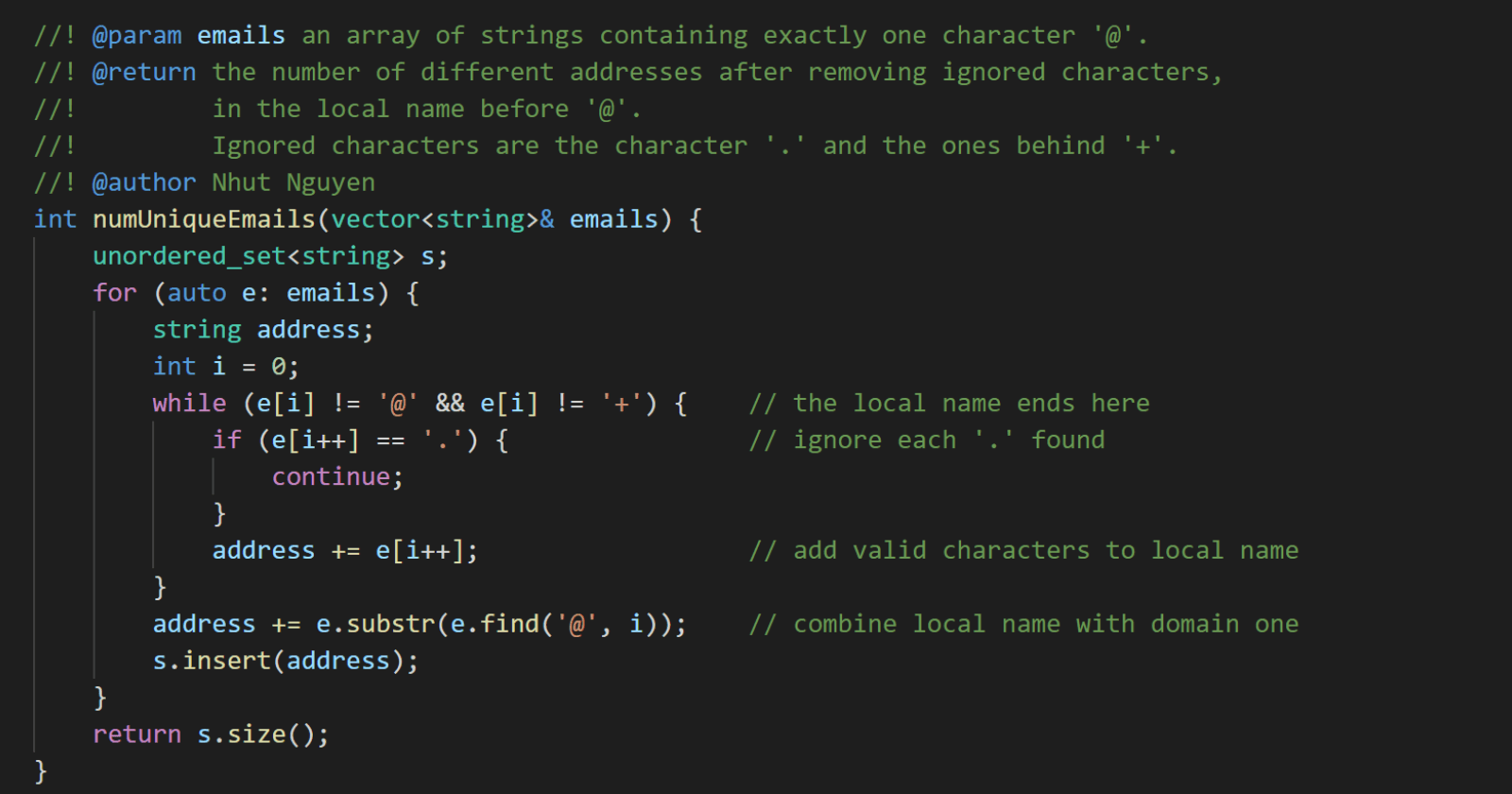
The runtime of removing characters in std::string is not constant. To avoid that complexity you can build up the clean email addresses from scratch.
#include<string>
#include<iostream>
#include<vector>
#include <unordered_set>
using namespace std;
int numUniqueEmails(vector<string>& emails) {
    unordered_set<string> s;
    for (auto e: emails) {
        string address;
        int i = 0;
        while (e[i] != '@' && e[i] != '+') {    // the local name ends here
            if (e[i++] == '.') {                // ignore each '.' found
                continue;
            }
            address += e[i++];                  // add valid characters to local name
        }
        address += e.substr(e.find('@', i));    // combine local name with domain one
        s.insert(address);
    }
    return s.size();
}
int main() {
    vector<string> emails = {"test.email+alex@leetcode.com",
                            "test.e.mail+bob.cathy@leetcode.com",
                            "testemail+david@lee.tcode.com"};
    cout << numUniqueEmails(emails) << endl;
    emails = {"a@leetcode.com","b@leetcode.com","c@leetcode.com"};
    cout << numUniqueEmails(emails) << endl;
    emails = {"test.email+alex@leetcode.com","test.email.leet+alex@code.com"};
    cout << numUniqueEmails(emails) << endl;
}
Output:
2
3
2
Runtime: O(N*M), where N = emails.length, M = max(emails[i].length).
Extra space: O(N*M).
string can be concatenated with a char and another string by + operator.std::string address = "name";
address += '@'; // "name@"
address += "domain.com"; // "name@domain.com"
count starting from the position pos of the string string.std::string address = "name@domain.com";
cout << address.substr(address.find('.')); // ".com"
cout << address.substr(0, address.find('@')); // "name"
char which appears in the string string starting from pos.Do not use std::set or std::map unless you want the keys to be in order (sorted). Use unordered containers like std::unordered_set or std::unordered_map instead. They use hashed keys for faster lookup.
Do not blindly/lazily use string.find(something). If you know where to start the search, use string.find(something, pos) with a specific pos.
Thanks for reading. Feel free to share your thought about my content and check out my FREE book “10 Classic Coding Challenges”.