48. Rotate Image
How to rotate a matrix
Problem statement
You are given an n x n 2D matrix representing an image. Rotate the image by 90 degrees (clockwise).
You have to rotate the image in-place, which means you have to modify the input 2D matrix directly. DO NOT allocate another 2D matrix and do the rotation.
Example 1

Input: matrix = [[1,2,3],[4,5,6],[7,8,9]]
Output: [[7,4,1],[8,5,2],[9,6,3]]
Example 2

Input: matrix = [[5,1,9,11],[2,4,8,10],[13,3,6,7],[15,14,12,16]]
Output: [[15,13,2,5],[14,3,4,1],[12,6,8,9],[16,7,10,11]]
Constraints
n == matrix.length == matrix[i].length.1 <= n <= 20.-1000 <= matrix[i][j] <= 1000.
Solution: The math behind
For any square matrix, the rotation 90 degrees clockwise can be performed in two steps:
Transpose the matrix.
Mirror the matrix vertically.
Code
#include <iostream>
#include <vector>
using namespace std;
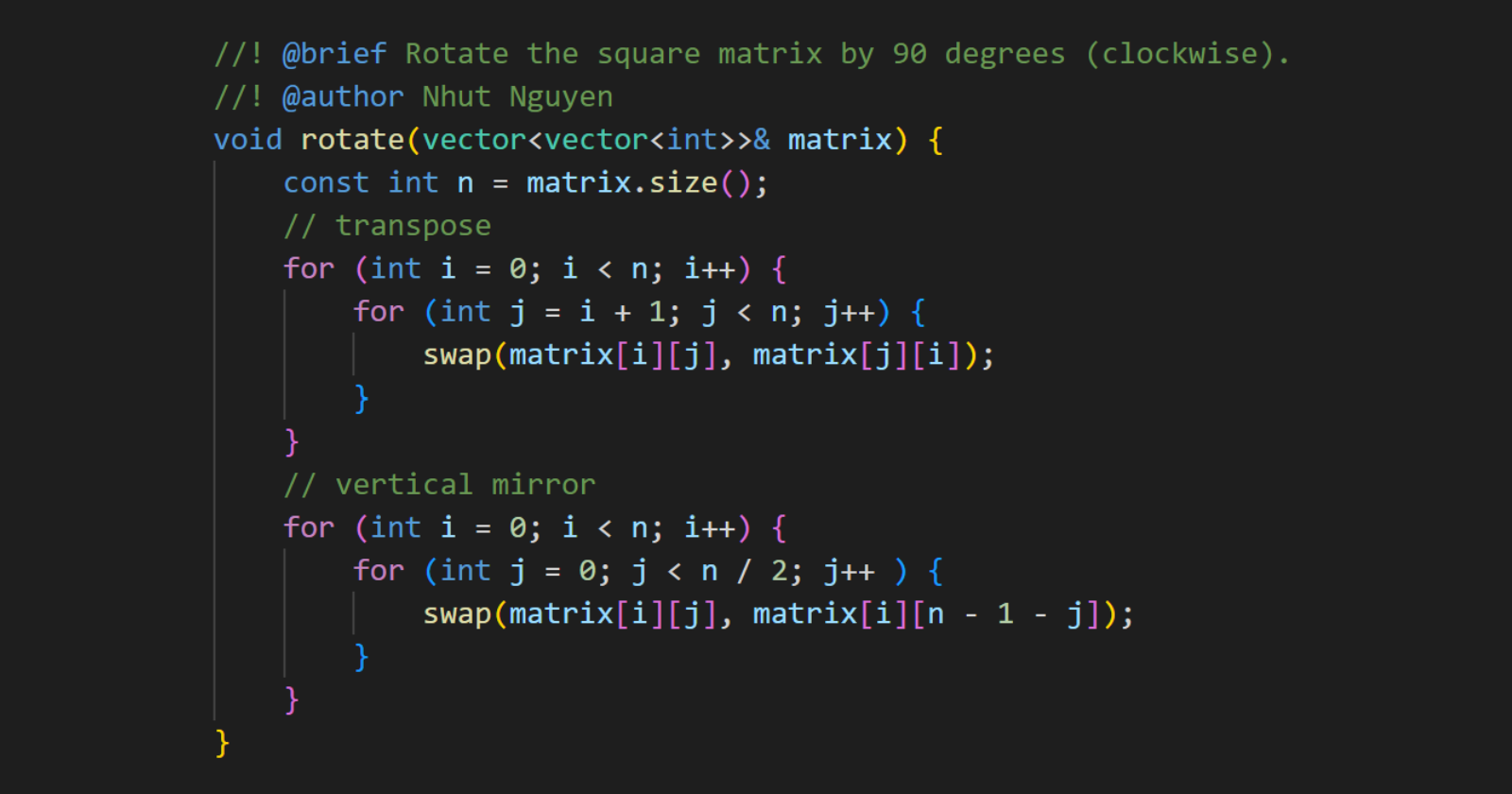
void rotate(vector<vector<int>>& matrix) {
    const int n = matrix.size();
    // transpose
    for (int i = 0; i < n; i++) {
        for (int j = i + 1; j < n; j++) {
            swap(matrix[i][j], matrix[j][i]);
        }
    }
    // vertical mirror
    for (int i = 0; i < n; i++) {
        for (int j = 0; j < n / 2; j++ ) {
            swap(matrix[i][j], matrix[i][n - 1 - j]);
        }
    }
}
void printMatrix(vector<vector<int>>& matrix) {
    cout << "[";
    for (auto& row: matrix) {
        cout << "[";
        for (auto& a: row) {
            cout << a << ",";
        }
        cout << "],";
    }
    cout << "]\n";
}
int main() {
    vector<vector<int>> matrix{{1,2,3},{4,5,6},{7,8,9}};
    rotate(matrix);
    printMatrix(matrix);
    matrix = {{5,1,9,11},{2,4,8,10},{13,3,6,7},{15,14,12,16}};
    rotate(matrix);
    printMatrix(matrix);
}
Output:
[[7,4,1,],[8,5,2,],[9,6,3,],]
[[15,13,2,5,],[14,3,4,1,],[12,6,8,9,],[16,7,10,11,],]
Complexity
Runtime:
O(n^2), wheren = matrix.length.Extra space:
O(1).
Implementation notes
The function
std::swapcan be used to exchange two values.When doing the transpose or mirroring, you could visit over one-half of the matrix.
Thanks for reading. Feel free to share your thought about my content and check out my FREE book 10 Classic Coding Challenges.
What is your approach? The problem was picked from leetcode.com. You can submit your solution in any programming language and check the performance.
About the author
Hi! My name is Nhut Nguyen. I am a software engineer and a writer in Copenhagen, Denmark.
Learn more about me at nhutnguyen.com
Comments
Join the discussionNo comments yet. Be the first to comment.